
Why the 48-Hour Bilona Method Produces the Only Real Desi Cow Ghee
Walk into any grocery store in Pakistan today. You will find shelf after shelf of golden jars, every one of them labelled “pure desi ghee.” Some even say “cow ghee.” A few print the word bilona in small script near the bottom.
Most of them are lying.
Not in a dramatic, illegal way. More in the quiet, industrial way that happens when shortcuts become standard, when a tradition that took 48 hours gets compressed into 40 minutes, when wood fire gets replaced by electric boilers, and when “cow milk” on a label means some cow milk blended with a great deal of buffalo milk, palm oil, or both.
This article is not a product pitch. It is an honest breakdown of what the bilona method actually is, why the wood fire step matters biochemically, and why cutting either one produces something that looks like ghee but functions very differently inside your body.
What the Bilona Method Actually Means — and What It Does Not
The word bilona comes from the Sanskrit root meaning “to churn.” In its traditional form, it describes a specific sequence:
- Fresh whole milk is fermented into thick curd (dahi) overnight using only its own natural bacterial cultures — no store-bought starter, no artificial acidifiers.
- The set curd is placed in a clay pot or matka. A wooden bilona (churning rod) is twisted by hand — or by rope — until the fat globules clump and rise as fresh butter (makhan).
- That makhan is then slow-cooked on a low, steady heat — traditionally wood fire — until all the water and milk solids separate out, leaving pure clarified fat behind.
What most brands skip: the fermentation and hand-churning steps.
Industrial ghee production collects cream directly off the milk, skipping the curd stage entirely. The cream is then centrifuged, pasteurised, and clarified at high heat in large boilers. This is faster — you can produce 1,000 kg of “ghee” in the time it takes a traditional farm to produce 20 kg — but the biochemical profile of the end product is fundamentally different.
The fermentation step is not ceremonial. Overnight curd fermentation by Lactobacillus cultures partially pre-digests the milk proteins and produces short-chain fatty acids, including the precursor compounds that, during slow cooking, contribute to ghee’s complex aroma and its naturally occurring butyrate content. Skip fermentation, skip butyrate formation.
Skip hand-churning, skip the mechanical separation that preserves these fragile lipid compounds intact.
The Wood Fire Variable: Why It Is Not Nostalgia
When Field N Feather’s pure desi cow ghee is described as “wood fire cooked,” it raises an obvious question: does the heat source actually matter, or is this just marketing language for tradition’s sake?
The answer is temperature consistency and heat profile.
Wood fire produces radiant heat with natural temperature oscillation — it rises and falls slowly rather than holding a precise electric setting. This matters because the clarification of makhan into ghee is a moisture-removal process. The milk solids (khoya) must brown gently at the bottom of the vessel — a process called the Maillard reaction — producing the nutty aroma compounds (pyrazines and furans) that distinguish real desi ghee from flat, flavourless industrially produced clarified butter.
Achieve this slowly on a low wood fire: the milk solids caramelise evenly, the aroma compounds form fully, and the remaining moisture escapes gradually.
Apply high electric or gas heat: the milk solids scorch unevenly, some aroma compounds burn off, and the ghee is filtered out quickly to prevent burning — leaving behind a paler, less complex product.
This is why real desi ghee has a deeper golden colour and a richer, almost nutty smell when you open the jar. Those are not marketing descriptions. They are the smell of the Maillard compounds formed properly during a slow wood fire cook.
The Milk Question: 25 to 30 Litres Per Kilogram
Here is the arithmetic that no one in the cheap ghee market wants consumers to think about.
It takes 25 to 30 litres of pure desi cow milk to produce 1 kilogram of real bilona ghee.
Desi cow milk (from breeds like Sahiwal or Tharparkar) contains approximately 3.5% to 4.5% fat — lower than buffalo milk (which sits at 7% to 8%; see desi cow ghee vs buffalo ghee). After fermentation, churning, and cooking, you are left with the pure fat fraction. The water, proteins, and lactose are all removed.
If a brand sells 1 kg of “cow ghee” at Rs. 800 — and fresh desi cow milk costs Rs. 150 to Rs. 200 per litre in Pakistan — the maths do not work. You cannot profitably sell real desi cow ghee at that price. What you can sell is a blend: buffalo milk cream (cheaper, higher fat yield), palm oil, or vanaspati topped with a small percentage of cow ghee for smell.
Field N Feather desi ghee is priced honestly at Rs. 1,200 for 250g, Rs. 2,300 for 500g, and Rs. 4,200 for 1 kg (full breakdown in our desi ghee price guide) — because these prices reflect the actual cost of 25 to 30 litres of milk, two days of traditional processing, and zero adulteration. The brand backs this with a full purity refund guarantee: if you can prove impurity, you get your money back. No other ghee brand in Pakistan currently makes that offer publicly.
How to Test Real Desi Ghee at Home — Before You Trust Any Brand
You do not need a laboratory. Three simple tests tell you most of what you need to know. Our full guide on how to check if desi ghee is pure goes deeper.
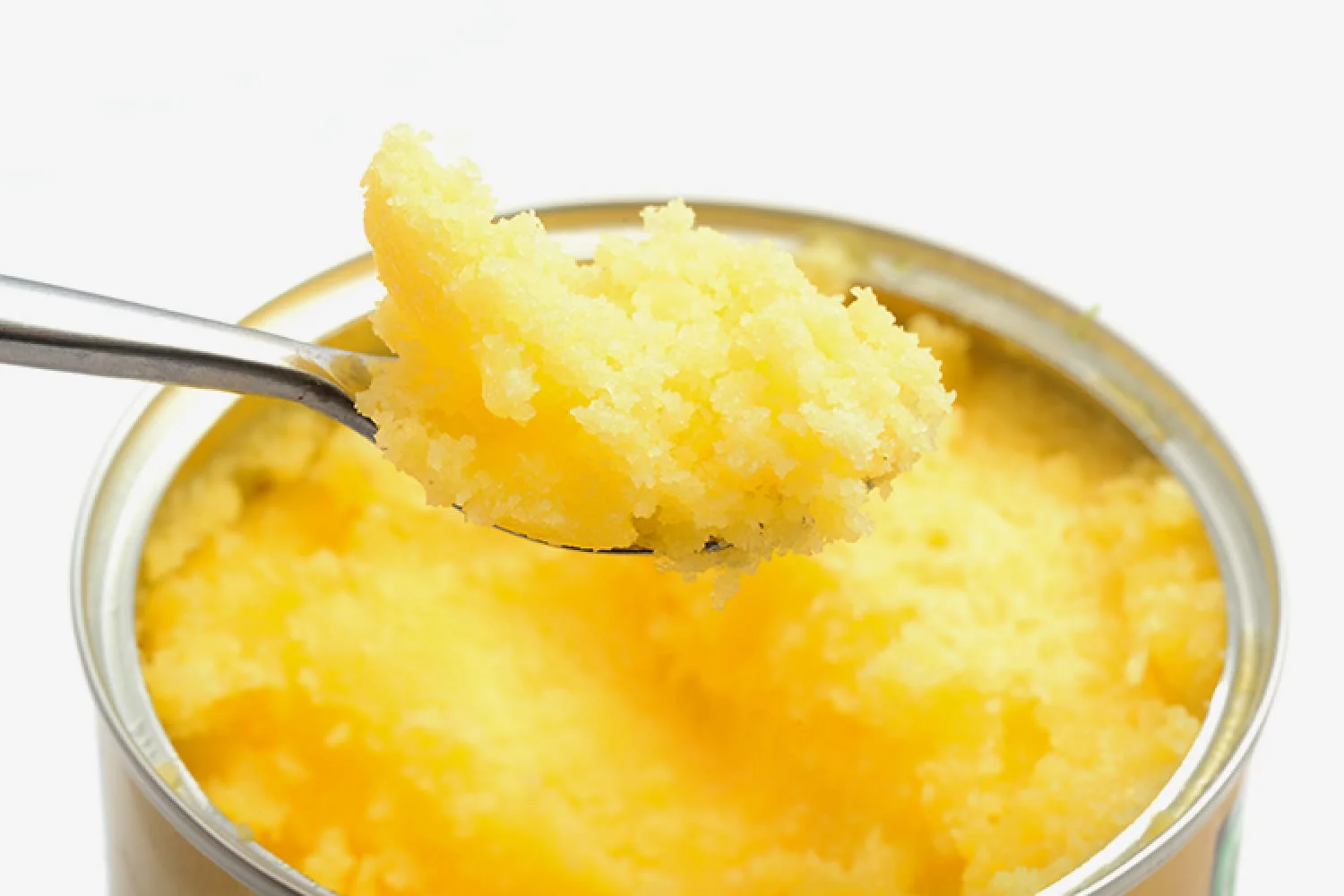
The Fridge Test Place a tablespoon of ghee in a small bowl in your refrigerator for 2 hours. Real bilona desi cow ghee will turn solid and slightly grainy — this is the natural crystallisation of short-chain fatty acids. Adulterated ghee or palm oil blends will either stay semi-liquid or turn uniformly smooth without any grain.
The Heat Test Add a teaspoon to a hot pan on medium flame. Genuine ghee melts instantly, spatters briefly as residual micro-moisture escapes, and then turns clear with a strong, nutty aroma within seconds. Buffalo ghee or blended products take longer to melt evenly, and the aroma is flatter — more like butter than the complex nutty-caramel smell of proper bilona ghee.
The Palm Test Place a small amount on your palm and rub it in. Real cow ghee absorbs smoothly and feels light. Palm oil blends leave a waxy, slow-absorbing residue that coats the skin rather than sinking in.
Field N Feather openly invites customers to apply all three tests to every batch they receive. That is the level of confidence that comes from owning your own cows and controlling every step of production.
Who Actually Benefits from Pure Desi Cow Ghee — And How
The health benefits of real bilona ghee are not the same as the benefits of industrial clarified butter. The distinction matters because the bioactive compounds are process-dependent.
Brain and Cognitive Function Bilona ghee made from grass-fed desi cow milk contains Omega-3 fatty acids and conjugated linoleic acid (CLA). These support neurological function and daily cognitive clarity. The fat-soluble Vitamins A, D, E, and K present in grass-fed cow ghee are in their most bioavailable form — far more so than in synthetic supplements.
Gut Health and Digestion The butyrate content of properly made bilona ghee is its most distinctive functional property. Butyrate is a short-chain fatty acid that is the preferred energy source for colonocytes — the cells lining your colon. A healthy supply of dietary butyrate supports the integrity of the gut lining, reduces inflammation, and aids digestion of heavy foods. This is why traditional Pakistani medicine has always recommended a spoonful of asli ghee in khichri or daal — it was not superstition. It was applied nutritional knowledge.
Safe for Babies A small amount of pure desi cow ghee mixed into soft khichri after 6 months supports healthy weight gain and early brain development. The fat is dense, easily metabolised, and contains none of the trans fats or hydrogenated oils found in vanaspati or cheap cooking oils. Always confirm with your paediatrician for your child’s specific needs.
Safe for Pregnant Women The Vitamin A and D content of grass-fed desi cow ghee supports foetal bone development, and the natural energy density is beneficial during pregnancy when caloric needs increase. Traditional South Asian cooking has included ghee in diets for pregnant women for centuries — a practice that modern nutritional science largely validates when the ghee is genuinely pure.
High Smoke Point for Pakistani Cooking At approximately 250°C, bilona desi cow ghee has a significantly higher smoke point than refined sunflower oil (~200°C) and far higher than extra virgin olive oil (~160°C). This means it does not oxidise and produce harmful compounds when used for tarka, bhunao cooking, or frying at typical household temperatures. The oil you cook with matters as much as what you put in the food.
The Grass-Fed Difference: Why What the Cow Eats Changes What You Eat
Not all cow ghee is equal — even when it is genuinely made from cow milk. The nutritional profile of the ghee tracks directly to what the cow ate.
Grain-fed cows produce milk with a lower Omega-3 to Omega-6 ratio and lower CLA content. Grass-fed cows — pastured on open land, eating natural vegetation — produce milk with measurably higher CLA, higher Omega-3s, and a richer Vitamin K2 content (specifically MK-4, the menaquinone form that supports bone and cardiovascular health).
Field N Feather’s cows are grass-fed and hormone-free, raised on their own farm. The farm owns the cows, collects fresh milk every morning, and has no dependency on open-market milk — which means no batch contamination from unknown sources, no seasonal quality variation from pooled milk of different animals, and complete traceability from cow to jar.
This is the part of the desi ghee production process that most brands cannot truthfully replicate — because most brands are not farms. They are processors buying milk from whoever sells it cheapest that week.
Why Most Desi Ghee in Pakistan Is Not What It Claims to Be
Pakistan’s dairy market is structurally set up in a way that makes adulteration easy and detection difficult.
Buffalo milk dominates Pakistani dairy production — roughly 70% of total milk output — because buffalo are more productive per animal and less expensive to maintain than desi cows. Buffalo ghee is cheaper to produce and has a higher fat yield per litre. It is not harmful, but it is a different product with a different fatty acid profile, a different aroma, and a different texture than pure desi cow ghee.
Palm oil adulteration is also common. Palm oil has a similar melting point to ghee, is vastly cheaper, and can be blended in proportions that pass a casual visual inspection.
The result: the majority of what is sold as “desi cow ghee” in Pakistan’s markets contains buffalo milk fat, palm oil, or both — and the consumer has no reliable way to distinguish it at point of sale.
This is the context in which Field N Feather’s guarantee means something. A purity refund offer is easy to make if you are confident. It is impossible to sustain if you are blending.
Ordering Pure Desi Cow Ghee Online in Pakistan — What to Know
Field N Feather delivers pure desi cow ghee across Pakistan — Karachi, Lahore, Islamabad, Multan, Faisalabad, Peshawar, and all major cities. Delivery takes 2 days.
Available sizes:
- 250g — Rs. 1,200
- 500g — Rs. 2,300
- 1KG — Rs. 4,200
Every jar is sealed fresh at the farm, not warehoused. Because production is batch-based and tied to fresh milk collection, availability can be limited during peak demand periods — particularly around Ramadan and wedding seasons when ghee consumption spikes nationally.
If you have been using market ghee and wondering why homemade food “used to taste different” when your grandmother made it — this is likely why. The ingredient was never quite the same.
Order genuine bilona desi cow ghee directly from the farm and apply the three home tests when it arrives. The difference will be immediately clear.
Summary: What Makes Real Desi Ghee Real
| Factor | Genuine Bilona Desi Cow Ghee | Industrial / Market Ghee |
|---|---|---|
| Milk source | Own farm, grass-fed desi cows | Open market, mixed sources |
| Processing | 48-hour fermentation + hand-churning | Cream separation, centrifuge |
| Heat source | Low wood fire | Electric / gas boilers |
| Additives | None | Buffalo milk, palm oil, colouring |
| Butyrate content | High (from fermented dahi) | Low to negligible |
| Texture when cold | Grainy, solid | Smooth or semi-liquid |
| Aroma | Rich, nutty, complex | Flat or artificial |
| Price (1kg) | Rs. 3,500+ (honest cost) | Rs. 600–1,200 (blended) |
Field N Feather is a Pakistan-based organic farm producing grass-fed desi cow ghee, free-range poultry, and farm-raised meat. All products are made on their own farm with no middlemen. Visit the shop or contact the team for bulk orders and restaurant supply.