
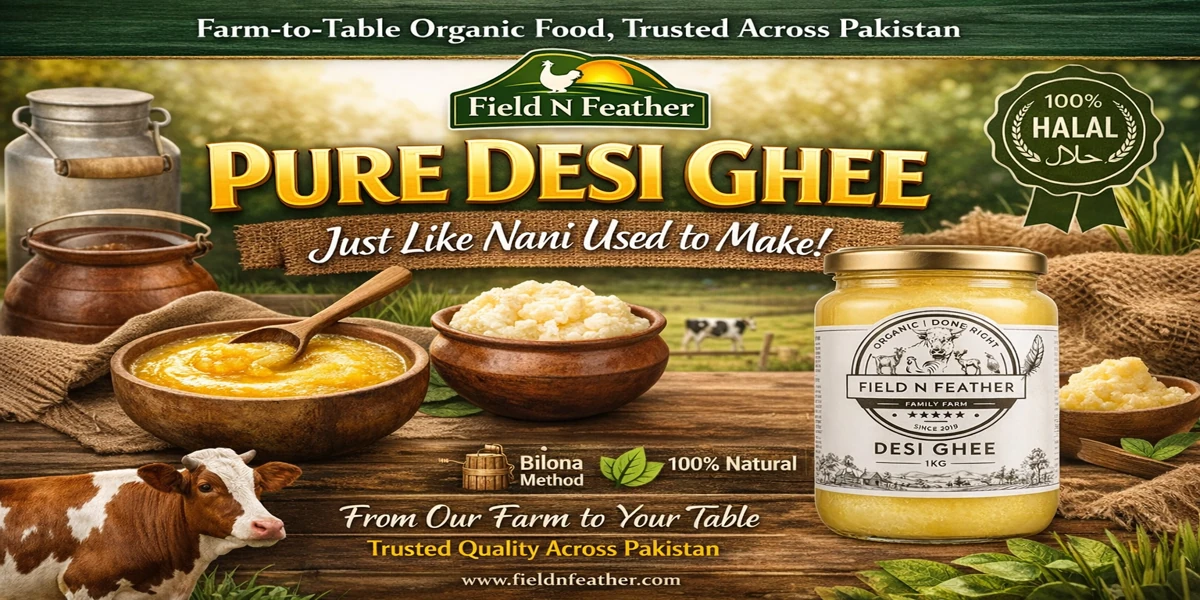
What Is Pure Desi Cow Ghee — and Why Does It Matter in Pakistan?
Pakistan has a problem with ghee.
Studies from PCSIR (Pakistan Council of Scientific and Industrial Research) have repeatedly found ghee samples in local markets containing vegetable oil, palm oil, buffalo fat, and artificial colouring, all sold as “pure desi ghee.” Here is how to check if desi ghee is pure at home.
This isn’t a small or occasional issue. It’s widespread. Most ghee on shelves — in grocery stores, online shops, and local markets — is made from factory cream or mixed milk sources, not fresh desi cow milk.
Pure desi cow ghee is something else entirely. It starts with fresh cow milk, fermented overnight into dahi, hand-beaten into makhan, then slow-cooked until pure golden ghee separates. That process takes 48 hours. It requires 25 to 30 litres of fresh cow milk to produce just 1 kilogram of ghee.
That yield explains the price. And it explains why cheap market ghee almost never is what it claims to be.
The Bilona Method: How Real Desi Ghee Is Made?
Most people have eaten ghee their whole lives without knowing how it’s supposed to be made.
The bilona method is the traditional process — used across Pakistan and South Asia for generations. Here’s what it actually involves:
Step 1 — Fresh milk collection. Milk is collected every morning from grass-fed desi cows. Not open-market milk. Not factory cream. Fresh milk, same day.
Step 2 — Overnight fermentation. The milk is naturally fermented into thick dahi using no artificial cultures. This step takes the full night.
Step 3 — Hand-churning into makhan. The next morning, the dahi is hand-beaten — the bilona method — until fresh makhan (cultured butter) separates out. No machines. No factory equipment.
Step 4 — Wood fire slow cook. The makhan is cooked on a low wood fire until pure ghee separates naturally from the milk solids. The moment of separation — when the solid bits brown and the fat turns golden — is what releases that nutty, rich aroma you remember from your grandmother’s kitchen.
The whole process, from fresh milk to sealed jar, takes 48 hours.
At Field N Feather, this is how every batch is made. They own their own cows. Milk is collected every morning from grass-fed, hormone-free desi cows on their own farm in Pakistan. No middlemen. No open-market milk. No shortcuts.
Pure Cow Ghee vs Buffalo Ghee vs Market Ghee: What’s the Difference?
This is a question most people don’t ask until they’ve already bought the wrong thing.
Pure desi cow ghee is made exclusively from desi cow milk. It’s lighter in colour — naturally golden, sometimes pale yellow. The texture is grainy when cold. The aroma when it hits a hot pan is distinctly nutty and rich. It contains CLA (conjugated linoleic acid), Omega-3 fatty acids, and fat-soluble vitamins A, D, E, and K in higher concentrations than buffalo ghee. Read the full desi cow ghee vs buffalo ghee comparison.
Buffalo ghee is heavier, whiter, and has a higher fat content. It’s not inherently bad — it’s just different. The problem in Pakistan is that many brands mix cow and buffalo milk without disclosing it, or sell buffalo ghee as “desi cow ghee” with artificial golden colouring.
Market or factory ghee is often made from cream (not fermented dahi), processed at high heat with industrial equipment. The bilona step — where hand-churning of fermented curd creates the distinct nutrient profile — is skipped entirely. Some factory ghee contains vegetable oil or palm oil as a filler.
The difference isn’t just about taste. Skipping fermentation and the bilona process changes the nutritional profile. Butyric acid levels — responsible for gut health benefits — are significantly higher in bilona-method ghee from grass-fed cow milk.
6 Health Benefits of Pure Desi Cow Ghee
These benefits apply specifically to 100% pure desi cow ghee made using the bilona method — not to adulterated or factory-processed ghee.
1. Gut health. Pure cow ghee is rich in butyric acid — a short-chain fatty acid that soothes the stomach lining and supports healthy digestion. In traditional medicine across Pakistan, warm desi ghee mixed with roti has been used for generations for acidity and bloating.
2. Brain function. Desi cow ghee contains Omega-3 fatty acids and CLA that support memory and daily cognitive function. Fat-soluble vitamins in ghee help the brain absorb nutrients from other foods in the same meal.
3. Vitamins A, D, E, and K. Grass-fed cow milk is a natural source of fat-soluble vitamins that support bone strength, immunity, and skin health. Because these vitamins are fat-soluble, ghee is one of the most effective delivery vehicles for them.
4. No trans fats. Unlike vanaspati (hydrogenated vegetable oil) and most refined cooking oils, pure desi cow ghee contains zero trans fats. It also has a high smoke point — around 250°C — making it safer for the high-heat cooking that Pakistani recipes require.
5. Good for babies. A small amount of desi cow ghee in khichri or soft roti, introduced after 6 months, supports healthy weight gain, brain development, and bone strength in infants. Always check with your paediatrician for your baby’s specific needs.
6. Good for pregnancy. Desi ghee provides natural energy, essential fatty acids, and fat-soluble nutrients that support both mother and baby during pregnancy. It has been used in traditional Pakistani and South Asian diets for this purpose for centuries.
How to Test Desi Ghee Purity at Home?
You don’t need a lab. Three simple tests tell you most of what you need to know.
The fridge test. Put a small amount in the refrigerator. Pure desi cow ghee will turn solid and grainy when cold. Uniform, smooth, or waxy consistency after chilling is a sign of adulteration.
The heat test. Melt a small amount in a pan. Real desi ghee melts almost instantly and releases a strong, nutty aroma within seconds. If it takes time to melt, smells flat, or produces a heavy oil smell, it’s likely mixed or adulterated.
The palm test. Rub a small amount between your palms. Pure ghee absorbs smoothly and cleanly, leaving a light, pleasant residue. Waxy or sticky residue suggests palm oil or vegetable fat content.
Field N Feather’s pure desi cow ghee passes all three — and they back it with a full refund if you can prove otherwise. No other brand in Pakistan makes that offer.
Desi Ghee Price in Pakistan: Why Real Ghee Costs More
The most common question: why is pure desi cow ghee more expensive than market ghee?
The math is simple. It takes 25 to 30 litres of fresh desi cow milk to produce just 1 kilogram of real ghee.
When you see 1KG of ghee priced at Rs. 500 or Rs. 800, the question isn’t whether it’s cheap — it’s whether it’s real. At those prices, the maths don’t work for pure cow ghee. Something else is in the jar.
Field N Feather desi cow ghee prices:
Current sizes and desi ghee 1kg price in Pakistan: 250g Rs. 1,200 · 500g Rs. 2,300 · 1kg Rs. 4,200 – delivered in 2 days.
Pay by bank transfer at checkout. Delivered in 2 days to Karachi, Lahore, Islamabad, Multan, Faisalabad, Peshawar, and every other city in Pakistan.
Order pure desi cow ghee online →
Why Field N Feather Is Different From Other Brands?
Most ghee brands in Pakistan buy milk from open markets or use factory cream. They don’t own cows. They don’t know what the cows ate or how the milk was handled.
Field N Feather owns their cows. Every litre of milk comes from their own grass-fed, hormone-free desi cows on their farm in Pakistan. The process is the same every batch — fresh morning milk, overnight fermentation, hand-beaten makhan, wood fire cooking.
There are no machines at the churning step. There is no gas or electric heat. No palm oil. No buffalo milk. No artificial colour. No preservatives.
And if you can prove the ghee is impure, they refund you in full. No questions, no delays.
That guarantee exists because they know exactly what’s in every jar — because they made it themselves, from milk they collected that morning.
Frequently Asked Questions
What is pure desi cow ghee?
Clarified butter made from 100% desi cow milk using the bilona method — milk fermented overnight into dahi, hand-beaten into makhan, then slow-cooked on wood fire until pure ghee separates. No buffalo milk, no palm oil, no additives.
What is the bilona method?
The traditional South Asian process for making ghee. Milk is fermented into dahi, then hand-churned to extract makhan (cultured butter), which is then slow-cooked into ghee. It preserves butyric acid and nutrients lost in industrial ghee processing.
What is the price of pure desi cow ghee in Pakistan?
Field N Feather sells pure desi cow ghee at Rs. 1,200 for 250g, Rs. 2,300 for 500g, and Rs. 4,200 for 1KG. delivered across Pakistan in 2 days.
Is desi cow ghee good for babies?
A small amount introduced after 6 months supports weight gain, brain development, and bone strength. Consult your paediatrician for your baby’s specific needs.
How do I know if my desi ghee is pure?
Fridge test (grainy when cold), heat test (melts fast with a nutty aroma), palm test (absorbs cleanly, no waxy residue). Pure ghee passes all three.
Is desi cow ghee better than buffalo ghee?
They serve different purposes. Desi cow ghee is lighter, higher in CLA and Omega-3s, and more suitable for daily use and cooking. Buffalo ghee is heavier and higher in total fat. The issue in Pakistan is mislabelling — not that buffalo ghee is bad, but that it’s frequently sold as cow ghee.
Can I Buy Desi Ghee Online In Pakistan?
Yes. Field N Feather delivers to Karachi, Lahore, Islamabad, Multan, Faisalabad, Peshawar, and all major cities across Pakistan. Orders are placed.
Looking for Pakistani recipes that use pure desi cow ghee? See our recipe guide →
Want to know how Field N Feather compares to other brands? Read our best desi ghee in Pakistan guide →