
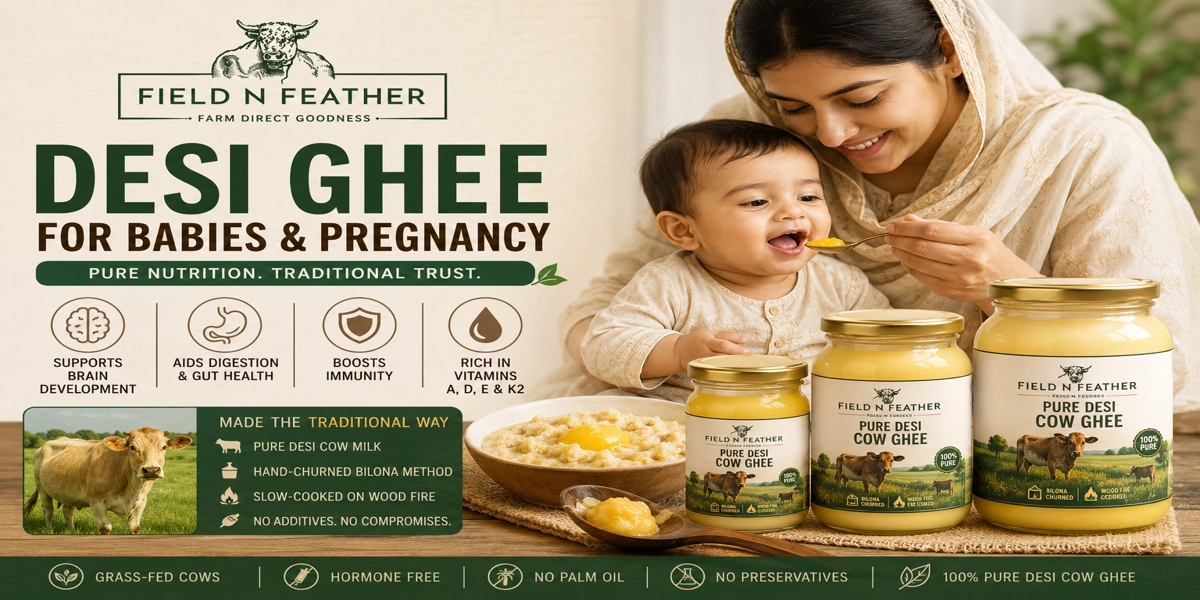
Desi Ghee for Babies and During Pregnancy — What Pakistani Mothers Need to Know
By Field N Feather | Pakistan’s most trusted farm-direct desi ghee brand
Every Pakistani nani knows. Before a new mother even leaves the hospital, someone in the family is already talking about ghee — how much she should eat, whether to add it to the baby’s khichri, which brand is actually pure. It is one of those subjects where traditional wisdom and modern anxiety collide in the most domestic way possible.
So let’s settle this properly: is pure desi cow ghee actually safe and beneficial for babies and during pregnancy? And if so, how much, from what age, and — most importantly — which kind?
Why Pakistani Families Have Always Used Desi Ghee for Babies?
This isn’t a trend. Ghee has been used in South Asian infant nutrition for thousands of years, and for practical reasons that predate nutritional science by centuries.
When researchers finally began studying the composition of traditional foods, they found that many of the intuitions were correct.
Pure desi cow ghee is rich in:
- Butyric acid (butyrate) — a short-chain fatty acid that feeds the cells lining the gut wall, supports digestion, and may reduce intestinal inflammation. For babies whose digestive systems are still developing, this matters.
- Fat-soluble vitamins A, D, E and K2 — these are not stored in water; they require fat to be absorbed. Breast milk alone may not deliver sufficient quantities, particularly Vitamin D and K2. Ghee from grass-fed cows provides these in bioavailable form.
- DHA-supportive fats — while ghee is not itself high in DHA, the fat matrix it provides supports the brain’s ability to use and retain omega-3 fatty acids. Early brain development between 6 months and 2 years is rapid, and adequate dietary fat is not optional.
- No trans fats, no additives — pure desi cow ghee has none of the harmful compounds found in refined cooking oils and hydrogenated fats. For a baby’s developing system, this clean profile is genuinely preferable.
The traditional practice of adding a small amount of ghee to a baby’s first solid foods was not arbitrary. It was efficient caloric supplementation from a source that was easy to digest, nutrient-dense, and stable.
At What Age Can You Introduce Desi Ghee for Babies?
The standard guidance from Pakistani paediatricians and WHO-aligned feeding recommendations is consistent: solid foods can be introduced from 6 months of age, and ghee can be part of that introduction from day one of complementary feeding.
There is no need to wait. Ghee is not an allergen in the conventional sense — it contains negligible milk protein (the casein and whey are largely removed during the clarification process). This makes it far more tolerable for infants than butter or cream.
Practical starting point: Start with a small amount — roughly ¼ to ½ teaspoon — stirred into soft khichri, dal, or mashed rice. This provides caloric density without overwhelming a small stomach.
As the baby grows: By 8 to 10 months, when intake of solid foods increases, you can use up to 1 teaspoon per meal. This remains true through the toddler years, and many nutritionists recommend ghee as a preferred cooking fat for children under 5 because of its high smoke point and absence of harmful compounds.
What you are not looking for: You are not trying to supplement aggressively. The goal is steady enrichment of the diet — not ghee at every meal or in large quantities. A little, consistently, goes further than a lot occasionally.
Desi Ghee for Baby Weight Gain — Does It Actually Work?
Yes, with an important qualifier: desi cow ghee supports healthy weight gain as part of a varied, nutritious diet. It is not a substitute for adequate breastfeeding or a well-rounded complementary diet.
Ghee is calorie-dense at approximately 900 kcal per 100g. For babies who are underweight or slow to gain, adding ghee to existing meals is one of the simplest and most culturally appropriate ways to increase caloric intake without forcing larger meal volumes.
However, if a baby is consistently underweight or failing to thrive, please consult a paediatrician. Ghee is a supplement to good care, not a replacement for it.
Desi Ghee During Pregnancy — What Pakistani Mothers Should Know
There is a lot of conflicting advice on this. Some sources say avoid ghee entirely due to fat content. Others recommend daily consumption as a traditional necessity. The truth is somewhere more nuanced.
The honest answer: Pure desi cow ghee, consumed in moderation, is a genuinely good dietary fat during pregnancy. Here’s why:
1. Fat-soluble vitamins the foetus needs The developing foetus requires fat-soluble vitamins — especially A, D, E and K — for organ development, bone formation, and immune programming. These are delivered efficiently through dietary fat. Ghee from grass-fed cows is one of the most concentrated natural sources of these vitamins available in the Pakistani diet.
2. Energy and caloric support in the third trimester The final trimester requires an additional 300–500 calories per day above baseline. Ghee provides concentrated, clean energy that doesn’t spike blood sugar the way refined carbohydrates do. A teaspoon of ghee in dal or added to roti is one of the most time-tested ways Pakistani women have met this need.
3. Butyrate and gut health during pregnancy Pregnancy significantly alters gut microbiome composition. Butyrate-rich foods support the gut lining and may reduce digestive discomfort — constipation and bloating are common complaints during the second and third trimesters, and dietary fat supports bowel regularity.
4. No evidence it causes harm in moderate amounts The concern about ghee and heart health during pregnancy is often based on research into industrial trans fats and highly processed saturated fats — not traditional clarified butter from grass-fed cows. These are fundamentally different substances.
What moderation looks like: 1 to 2 teaspoons per day, used as a cooking fat or added to food, is a reasonable and traditional amount. This is not a medical dose — it is the ordinary culinary use that generations of South Asian women have practiced.
Who should exercise caution: Women with gestational diabetes, high cholesterol, or weight management concerns during pregnancy should consult their obstetrician before changing their fat intake. Ghee is not inherently problematic for these conditions, but individual medical guidance should always take precedence.
Why the Source of Ghee Matters for Babies and Pregnant Women?
This is where the conversation gets specific. Not all desi ghee is the same, and when you are giving something to a baby or consuming it during pregnancy, the quality of the source is not a minor detail.
The problems with commercial market ghee:
- Many products contain buffalo milk blended with palm oil or vegetable shortening
- Artificial colouring agents are sometimes added to mimic the golden color of pure cow ghee
- Preservatives may be used to extend shelf life in ways that bypass quality
- There is no reliable way to verify purity from a label alone
What to look for specifically for babies and pregnancy:
- Pure desi cow milk — not buffalo, not blended
- Grass-fed animals — the vitamin and CLA content of ghee from grass-fed cows is measurably higher
- Hand-churned bilona method — this preserves more of the natural fat structure than industrial cream separation
- Wood fire or slow-cooked preparation — lower temperatures retain more heat-sensitive nutrients
- No additives — nothing added, ever
Field N Feather’s pure desi cow ghee meets every one of these standards. The cows are grass-fed and hormone-free. The milk is collected fresh every morning from the farm’s own herd. Every batch is hand-churned using the traditional bilona method and slow-cooked on wood fire. No buffalo milk, no palm oil, no artificial anything.
It is, in short, the kind of ghee Pakistani grandmothers would recognize. Which is exactly the point.
How to Use Desi Ghee for Babies — Simple Starting Ideas
| Age | Amount | How to Use |
|---|---|---|
| 6 months | ¼ tsp | Mixed into khichri or mashed dal |
| 7–9 months | ½ tsp | Stirred into soft vegetables, rice cereal |
| 10–12 months | 1 tsp | Added to any cooked meal; used to lightly sauté vegetables |
| 1–3 years | 1–2 tsp daily | As a cooking fat for family-style meals |
For pregnant women: 1–2 tsp per day as a cooking fat or drizzled over roti and dal is the simplest approach. Some women add a small amount to warm milk at night — a traditional practice with both nutritional and comfort merit.
The Bottom Line
Desi ghee is not a relic of an unscientific past. It is a traditional food whose benefits have held up remarkably well under nutritional scrutiny — particularly for the developing systems of infants and the increased nutritional demands of pregnancy.
The key is purity. A tablespoon of adulterated market ghee delivers none of the benefits and potentially introduces harm. A teaspoon of real, farm-made pure desi cow ghee — made from grass-fed cows, bilona-churned, wood fire cooked — is something else entirely.
That difference is exactly what Field N Feather was built to provide.
→ Order pure desi cow ghee, across Pakistan
Available in 250g, 500g, and 1KG. Delivered to Lahore, Karachi, Islamabad, Multan, Faisalabad, Peshawar, and all major cities in 2 days.
For more reading: