
Desi Ghee for Weight Gain: What Actually Works (An Honest Guide)
In most Pakistani households, when someone is trying to gain weight — a growing child, an elderly parent recovering from illness, a bride-to-be under pressure to “fill out” before the wedding — the first suggestion is almost always the same: “ghee khao.” Eat ghee.
It’s not just tradition talking. There’s real nutritional logic behind it. But there’s also a right way and a wrong way to use ghee for weight gain, and a lot of the advice circulating online skips the part that actually matters most: the quality of the ghee itself.
This guide covers what desi ghee actually does for weight gain, how much to realistically use, and why the source of your ghee changes the outcome more than any of the “tips and tricks” floating around.
Does Desi Ghee Actually Help With Weight Gain?
Yes — but not by magic, and not on its own. Desi ghee is calorie-dense fat: roughly 900 calories per 100 grams. Adding it to your daily meals increases your overall calorie intake, and a consistent calorie surplus is what drives weight gain, whether that surplus comes from ghee, rice, or anything else.
What makes ghee a better choice than simply eating more oily or fried food is how the body processes it:
- Ghee is largely made up of short- and medium-chain fatty acids, which the body can break down and use for energy more easily than the long-chain fats found in most cooking oils.
- It doesn’t spike insulin the way refined carbohydrates do, so the weight gained tends to be more stable rather than a quick spike followed by a crash.
- It carries fat-soluble vitamins A, D, E, and K, which support overall nourishment — useful when someone is underweight due to poor appetite or nutrient gaps, not just low calories.
In short: ghee helps because it’s an efficient, nutrient-carrying way to add calories to a diet — not because it contains some special weight-gain compound.
How Much Desi Ghee Should You Eat for Weight Gain?
There’s no universal number, since it depends on your current diet, activity level, and how much of a calorie surplus you actually need. But as a general starting point used traditionally in Pakistani households:
- 1–2 teaspoons with warm milk, once daily — commonly taken before bed, said to aid digestion and absorption overnight
- 1 teaspoon added to daal, khichri, or vegetables at mealtime, which also improves how well your body absorbs fat-soluble nutrients from those foods
- A generous layer on roti or paratha rather than a thin wipe — this is where most households already use ghee, just not always in a measured way
Building up gradually rather than adding a large amount all at once is the more sustainable approach — a sudden jump in fat intake can cause digestive discomfort before the body adjusts.
A note on this being general nutrition information: if you’re trying to gain weight for a medical reason, or the person trying to gain weight is a child, elderly, pregnant, or managing a health condition, it’s worth checking with a doctor or dietitian on quantities that suit their specific situation.
Why the Type of Ghee You Use Actually Matters
This is the part most “ghee for weight gain” advice skips entirely — and it’s the part that determines whether this actually works.
A large share of the “desi ghee” sold in Pakistan isn’t pure cow ghee at all. Lab testing by PCSIR has repeatedly found market ghee cut with vegetable oil, palm oil, or unlisted buffalo milk. When you’re eating ghee specifically to add clean, nutrient-dense calories, adulterated ghee undermines the entire point — you’re getting empty, low-quality fat instead of the vitamins and easily-digestible fatty acids that make real ghee useful in the first place.
This is also why real desi ghee costs what it does. Making one kilogram of genuine cow ghee the traditional way — hand-churned using the bilona method, then slow-cooked over a wood fire — takes 25 to 30 litres of fresh milk. Ghee priced well below that cost is very rarely pure.
If you want to understand exactly how to tell the difference before you buy, we’ve written a full breakdown here: Best Desi Ghee in Pakistan — What to Look for Before You Buy.
Cow Ghee or Buffalo Ghee for Weight Gain?
Both can support weight gain, but they behave differently:
- Cow ghee is lighter, easier to digest, and better tolerated for daily use — a better fit for children, elderly family members, or anyone with a sensitive stomach who needs to eat ghee consistently over weeks or months.
- Buffalo ghee is denser and richer, with a stronger flavor. It works well in cooking but can feel heavier when eaten in larger daily amounts specifically for weight gain.
For most households using ghee as a daily weight-gain aid, cow ghee tends to be the more sustainable choice simply because it’s easier to keep eating consistently.
Simple Ways to Add Desi Ghee to a Weight Gain Diet
You don’t need a complicated routine — just consistent, everyday use across meals you’re already eating:
- Morning: a teaspoon of ghee stirred into warm milk or paratha at breakfast
- Lunch/Dinner: ghee-finished daal or a generous serving on rice — the fat also helps your body absorb more of the nutrients from the meal itself
- Before bed: warm milk with a teaspoon of ghee, a traditional practice believed to support digestion overnight
For dishes where ghee is genuinely essential to the outcome — not just an add-on — our guide on Pakistani Recipes That Need Pure Desi Cow Ghee breaks down exact quantities for parathas, halwa, daal tadka, and more.
Who Should Be Careful With Ghee-Based Weight Gain
Ghee is a saturated fat. For most healthy people, moderate daily use as part of a balanced diet is fine. But a few groups should be more cautious and ideally check with a doctor first:
- Anyone with existing heart disease or high cholesterol
- People managing diabetes, since overall calorie and fat intake needs closer monitoring
- Anyone on a medically supervised weight-gain plan for an underlying condition
Using pure ghee in reasonable amounts is very different from bulk-consuming low-quality or adulterated ghee, which can carry unknown fat content and additives that make it harder to track what you’re actually eating.
Frequently Asked Questions
How long does it take to see weight gain results from ghee? This depends entirely on your overall calorie intake, not ghee alone. Since ghee is one part of a broader diet, most people see gradual change over several weeks of consistent use combined with adequate overall eating, not from ghee in isolation.
Can children use ghee for weight gain? A small amount of pure ghee mixed into khichri or soft roti is a traditional way to support healthy weight gain in children older than 6 months. Always check with a pediatrician for the right amount for a specific child.
Is ghee better than butter for weight gain? Ghee has slightly more concentrated fat since the water and milk solids are removed during cooking, and it’s easier for many people to digest since much of the lactose and casein is removed in the process.
Does adulterated ghee still help with weight gain? It will still add calories, but you lose the nutritional benefit that makes ghee a better choice than any other fat — and you have no way of knowing what’s actually in it. Pure, tested ghee is what makes this approach worthwhile in the first place.
The Real Starting Point: Pure Ghee
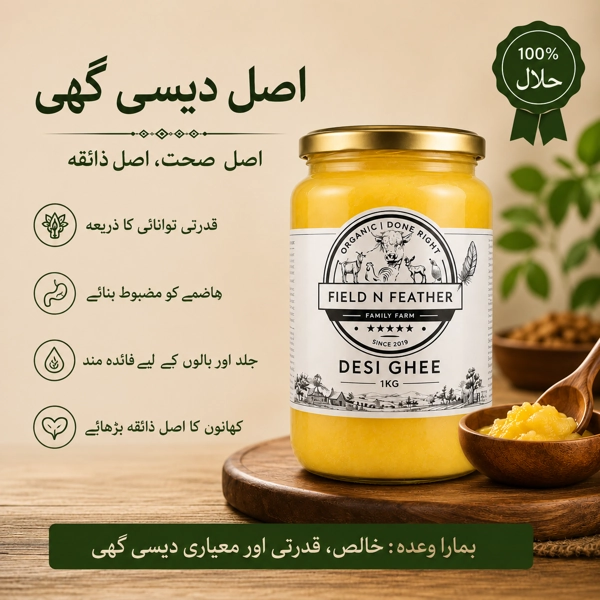
Weight gain through ghee only works the way it’s supposed to when the ghee itself is genuinely pure. Field n Feather’s desi cow ghee is made from 100% real cow milk from our own grass-fed herd — hand-churned using the traditional bilona method and slow-cooked over a real wood fire, with zero buffalo milk, palm oil, or additives. If you can prove otherwise, we refund you in full.
You can see the full process and order online here: Field n Feather Pure Desi Cow Ghee.