
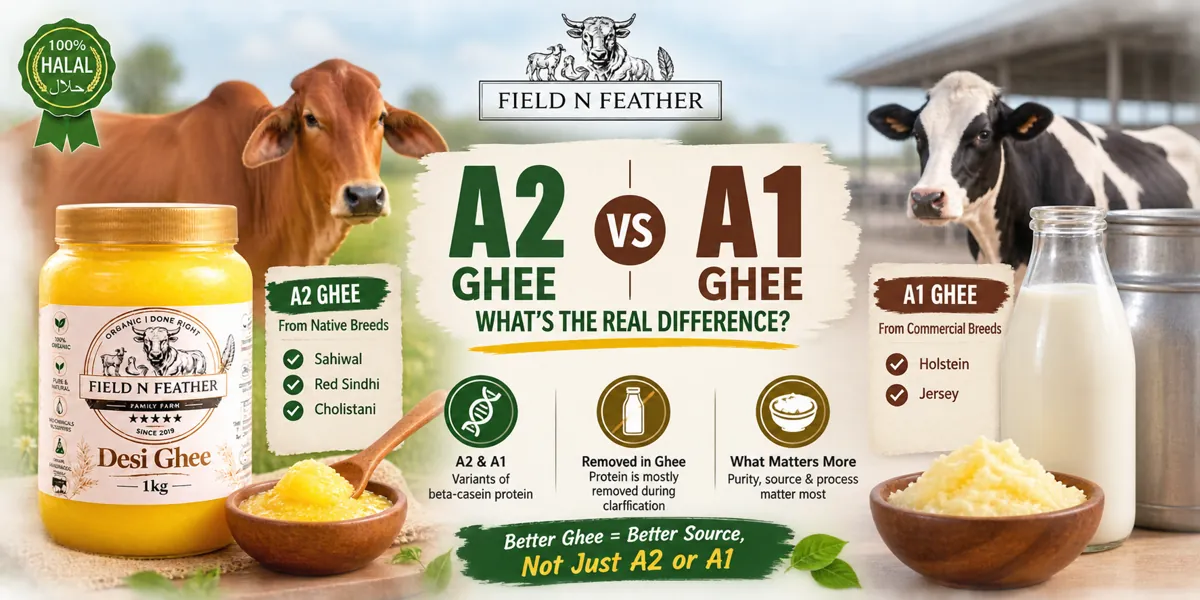
A2 Ghee vs A1 Ghee: What’s the Real Difference?
A2 and A1 refer to two forms of beta-casein, a protein found in cow’s milk. A2 milk comes from cows that produce only the A2 type, mostly native breeds like Sahiwal, Red Sindhi, and Gir.
Most commercial dairy cows (like Holstein) produce a mix of A1 and A2. The difference sits in the milk protein itself, and it’s worth understanding before you decide it matters for your ghee.
What is A2 milk and A1 milk?
Beta-casein is one of the main proteins in cow’s milk. A1 and A2 are two genetic variants of it, differing by a single amino acid.
When your body digests A1 beta-casein, it can release a peptide called BCM-7 (beta-casomorphin-7). Some people report that this peptide is harder on their stomach. A2 beta-casein breaks down differently and doesn’t release BCM-7 in the same way.
This is why some people who feel bloated or heavy after regular milk say they tolerate A2 milk better. It’s not an allergy, and it’s not the same as lactose intolerance — it’s a separate reaction some people report to this specific protein.
Which Pakistani cow breeds give A2 milk naturally?
Pakistan is home to several native cow breeds that produce A2 milk without any special breeding program:
- Sahiwal — one of the best dairy breeds in South Asia, common across Punjab
- Red Sindhi — hardy, heat-tolerant, found across Sindh and southern Punjab
- Cholistani — raised in the Cholistan desert belt, known for resilience
Foreign breeds like Holstein and Jersey, which many large commercial dairies use for higher milk yield, typically carry the A1 gene. So when a brand says its ghee comes from Sahiwal or Red Sindhi cows, that’s a real, verifiable reason to expect A2 milk — not just a marketing label.
Does the A1/A2 difference actually carry over into ghee?
Here’s the part most ghee brands don’t explain properly, and it matters.
Ghee is made by simmering butter until the milk solids and water separate out, leaving behind almost pure butterfat. Beta-casein is a protein, and protein is exactly what gets removed in that process. Properly made ghee contains only trace amounts of milk protein — nowhere near what’s in milk, curd, or paneer.
So the honest answer is this: once milk becomes real ghee, the A1/A2 distinction matters far less than it does for milk or dairy products you drink or eat with the protein still intact. If a brand promises “easier digestion” purely because of A2 milk in their ghee, take that with a pinch of salt.
What A2 milk sourcing does tell you, though, is something else entirely — where your ghee actually comes from. Ghee from native Sahiwal or Red Sindhi cows usually means a smaller, traceable herd, not an anonymous mixed-milk supply chain. That traceability is often the real reason people notice a difference — not the A1/A2 protein content, but the quality and purity of milk that comes from a single, well-kept herd.
So why do people still say A2 ghee “feels lighter”?
A few honest reasons, none of them mysterious:
- Purity. Ghee from a single traceable herd is less likely to be blended with buffalo milk, vegetable oil, or other cheaper fats — a real problem in Pakistan’s ghee market.
- Freshness. Small-batch ghee from a known source is usually fresher than mass-produced ghee sitting in a supply chain for months.
- The bilona method. Traditional hand-churning and wood-fire cooking produce a different texture and taste than machine-made ghee, which some people associate with feeling “lighter,” even though that’s about process, not A1/A2 protein.
None of this is a medical claim — if you have a specific digestive condition, talk to your doctor about what works for you.
Field n Feather’s approach
We raise our own herd of Sahiwal cows in Punjab — naturally A2, grass-fed, and hormone-free. But we don’t just lean on the “A2” label. Every batch of our desi ghee is bilona-churned and wood-fire cooked from our own milk, with full farm-to-table traceability back to our farm — not an open-market mixing tank.
That’s the part that actually matters: knowing exactly which cows, which farm, and which process your ghee came from. You can read more about how we work on our About Us page.
Frequently Asked Questions
Is A2 ghee better than regular ghee?
A2 ghee isn’t automatically “better” — but ghee made from a traceable, single-source A2 herd is often purer, since it usually comes from a smaller farm rather than a mixed commercial supply.
Is Sahiwal cow milk A2 or A1?
Sahiwal cows are a native South Asian breed that naturally produce A2 beta-casein milk.
Does the ghee-making process remove A1/A2 protein?
Yes, mostly. Ghee is nearly pure milk fat, and the beta-casein protein (whether A1 or A2) is largely removed during clarification. Only trace amounts remain.
Can people with lactose intolerance use A2 ghee?
Ghee, in general, is very low in lactose regardless of A1 or A2 source, which is why many people who avoid regular dairy still tolerate ghee comfortably. This is unrelated to the A1/A2 distinction.
Which is the best ghee to buy in Pakistan for purity?
Look for ghee that names its cow breed, farm source, and production method (like bilona and wood-fire cooking) rather than just saying “pure” or “organic” with no detail behind it.
Curious how our desi ghee is made from our own Sahiwal herd? Visit Field n Feather to see the full process, or order directly for nationwide delivery.